- hello@daggloballtd.com
- No. 3 Ebong Close Wealth avenue, Palmsbay estate Abijo G.R.A. Lekki Epe exrpress way, Lagos State, Nigeria

How Fintech is Transforming Business Payments in Nigeria
31
Jan
If you’ve ever tried running a business in Nigeria, you already know this truth: payments can make or break your day.
Not because customers don’t want to pay. They do. But because the process of collecting money used to be… let’s just say it wasn’t for the faint-hearted. Cash shortages. Fake notes. “No change.” POS wahala. Bank transfer delays. And those frustrating moments when a customer swears they’ve paid but your alert is playing hide and seek.
Now, here comes fintech — not as a loud savior with a trumpet, but as a quiet revolution reshaping how Nigerian businesses collect, send, and manage money.
From roadside vendors using QR codes to e-commerce brands sending payment links on WhatsApp, Nigeria’s payment culture is changing fast. And whether you’re running a mini-mart, a logistics company, a school, a salon, or a growing tech startup, you’re standing right in the middle of it.
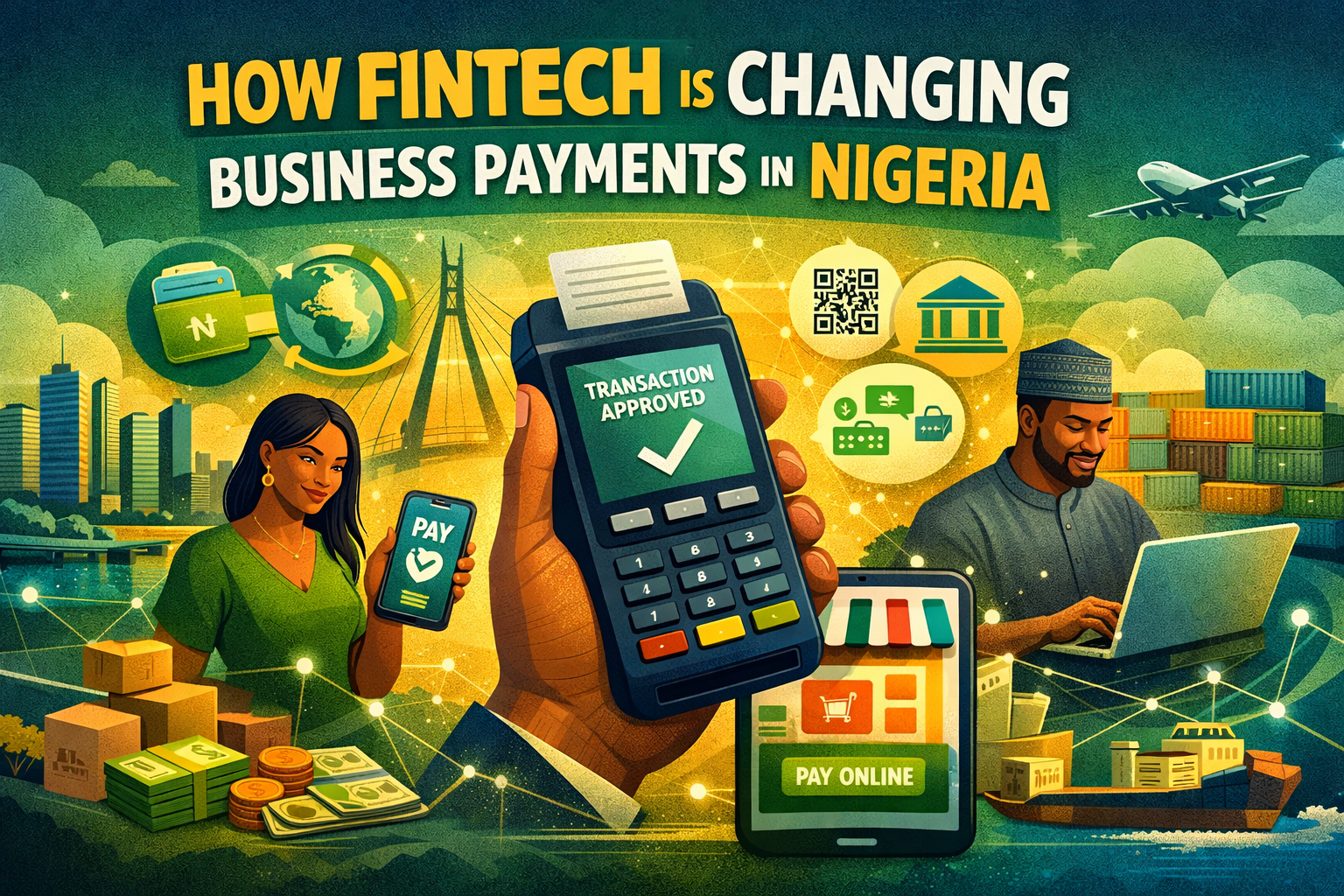
In this guide, we’ll explore How Fintech is Changing Business Payments in Nigeria, why it matters, what’s working, what’s still messy, and what the future looks like for Nigerian businesses that want to stay ahead of the curve.
What Fintech Really Means for Nigerian Business Payments
Fintech is short for “financial technology,” but honestly, that definition can feel too big and too academic. Let’s make it simple.
Fintech in Nigeria is any technology-driven service that makes money movement easier, faster, smarter, and more accessible — especially for businesses.
It’s the difference between:
Waiting for banking hours to confirm payments
vs
Seeing a transaction confirmed instantly on your dashboard at 11:47pm
It’s the difference between:
Manually writing down customer transfers in a notebook
vs
Automatically tracking payments, generating receipts, and reconciling accounts without stress
And the best part? You don’t need to be a tech guru to use fintech. If you can use WhatsApp, you can use most fintech payment tools.
Before Fintech: The Old Payment Struggles Nigerian Businesses Know Too Well
Ah, the “good old days.” Except they weren’t good.
Before fintech started becoming mainstream, Nigerian businesses relied heavily on cash and traditional banking methods. And while banks have always played a big role, the system wasn’t designed for the speed of modern commerce.
The cash-heavy hustle
Cash was king and still is in some places but it came with headaches:
Security risks (robbery, theft, missing cash)
Fake currency issues
Time wasted counting and sorting money
Cash flow confusion (money comes in but disappears into “expenses”)
Transfer delays and verification stress
Bank transfers were helpful, but they weren’t always smooth:
Delayed alerts
Reversed transactions
Customers sending screenshots as proof
Businesses unsure whether to release goods
Manual record-keeping and reconciliation chaos
Many businesses used notebooks, spreadsheets, or memory (God help us):
No clean transaction history
Difficult auditing
Hard to track profit
Mistakes that could cost real money
So when fintech arrived with speed, automation, and convenience, Nigerian businesses didn’t just like it , they needed it.
How Fintech is Changing Business Payments in Nigeria: The Real Transformations Happening Now
Let’s get into the heart of the matter. This isn’t theory. It’s happening in markets, malls, online stores, offices, schools, and logistics hubs across Nigeria.
Faster, Smoother, More Reliable Transfers (Most of the Time)
One of fintech’s biggest wins is how it has improved transfers and settlement.
Many fintech platforms now offer:
Instant bank transfers
Better transaction tracking
Faster confirmation
Automated receipts and payment notifications
For businesses, speed isn’t just convenience, it’s cash flow.
A fashion vendor who gets paid instantly can restock quicker. A restaurant that confirms payment immediately can serve faster. A logistics company can dispatch riders without waiting for “alert.” And honestly? That alone is a game-changer.
Payment Gateways: Fueling Nigeria’s Online Business Boom
Nigeria’s e-commerce scene has grown like wildfire, and fintech is basically the gasoline.
Payment gateways allow businesses to accept online payments through multiple channels, such as:
-
Debit cards
-
Bank transfers
-
USSD
-
QR codes
-
Mobile wallets
Now imagine you’re selling skincare products online. Without a payment gateway, your options are limited:
-
“Send to my account number”
-
“Drop transfer screenshot”
-
“Wait for alert”
But with a payment gateway?
Customers click a button, pay in seconds, and get confirmation instantly. You also get a clean record of every transaction. No drama.
This is one major reason Fintech is Changing Business Payments in Nigeria isn’t just a tech story, it’s a growth story.
POS Revolution: From “POS Wahala” to Business Lifeline
Let’s talk about POS.
For years, POS was either unreliable or limited. But fintech companies took POS and turned it into something bigger: a tool for financial inclusion and business expansion.
Today’s fintech-powered POS systems can:
-
Accept card payments
-
Process transfers
-
Offer cash withdrawals
-
Print receipts
-
Track sales
-
Sync with dashboards
And here’s the wild part: POS has become a business model on its own.
Many Nigerians now run POS businesses as:
-
Side hustle
-
Full-time income source
-
Community banking alternative
In rural and semi-urban areas, fintech POS agents are doing what banks couldn’t: bringing financial services to the streets.
Payment Links: The WhatsApp-Friendly Innovation Businesses Love
If you run a business in Nigeria and you’ve never used a payment link, you’re missing out on something sweet.
Payment links allow you to generate a link and send it to customers via:
-
WhatsApp
-
Instagram DM
-
Email
-
SMS
Customer clicks the link, pays, and you get confirmation.
No long account numbers. No copy-and-paste errors. No “I sent to the wrong account.”
It’s perfect for:
-
Freelancers
-
Social media vendors
-
Consultants
-
Digital product sellers
-
Service providers
In a country where WhatsApp is basically the marketplace, payment links are like giving your business a cash register inside the chat.
Mobile Wallets and Digital Banking: Businesses Going Beyond Traditional Accounts
Another shift fintech has brought is the rise of business wallets and digital banking platforms.
Instead of relying only on traditional bank accounts, businesses can now:
-
Hold money in wallets
-
Make bulk transfers
-
Separate business funds from personal spending
-
Track cash flow
-
Set spending controls for staff
For small businesses, this is powerful because it builds discipline. It turns “money in hand” into “money managed.”
Reconciliation Tools: The Silent Hero of Fintech Payments
Let’s be real, collecting money is one thing. Tracking it properly is another.
This is where fintech shines quietly.
Modern fintech solutions offer dashboards that show:
-
Daily sales totals
-
Transaction history
-
Failed vs successful payments
-
Settlement timelines
-
Customer payment records
This makes reconciliation easier.
No more guessing. No more “I think we made profit.” No more chaotic end-of-month calculations.
For growing businesses, reconciliation is the bridge between hustle and structure. And fintech provides that bridge.
Cross-Border Payments: Helping Nigerian Businesses Trade Beyond Borders
Nigeria is full of importers, exporters, freelancers, and global service providers. But cross-border payments used to be a nightmare:
-
Delays
-
High fees
-
Currency conversion stress
-
Limited access for SMEs
Fintech is changing that.
Some fintech platforms now support:
-
Faster international transfers
-
Better FX rates
-
Virtual cards for global payments
-
Cross-border invoicing
This matters because Nigerian businesses aren’t just competing locally anymore. They’re selling to the world.
Why This Fintech Shift Matters: Benefits for Nigerian Businesses
So what do businesses actually gain from fintech payment solutions?
Plenty.
1. Better Customer Experience
Customers want speed. They want convenience. They want options.
Fintech allows businesses to offer:
-
Card payments
-
Transfers
-
USSD
-
QR payments
-
Wallet payments
More options = more sales.
2. Improved Cash Flow
Cash flow is oxygen.
With instant confirmations and faster settlements, businesses can:
-
Restock quicker
-
Pay suppliers on time
-
Manage operations smoothly
3. Increased Trust and Professionalism
When your business can send:
-
Automated receipts
-
Transaction references
-
Payment confirmations
You look more professional. Customers feel safer paying you.
4. Reduced Cash Risks
Less cash handling means:
-
Less theft risk
-
Less fake currency
-
Less counting errors
5. Easier Business Scaling
A business that can track payments properly can scale properly.
Fintech tools help businesses grow from:
small hustle
to
structured brand
Real-Life Use Cases: How Nigerian Businesses Are Using Fintech Today
Fintech isn’t just for big brands. It’s for everyday commerce.
Retail stores and supermarkets
-
POS + bank transfer payments
-
Sales tracking dashboards
Online vendors
-
Payment links on Instagram and WhatsApp
-
Online checkout systems
Logistics companies
-
Bulk payouts to riders
-
Wallet systems for dispatch teams
Schools and training centers
-
Digital fee collection
-
Payment tracking per student
Restaurants and lounges
-
QR payments at tables
-
Faster checkout process
The Challenges: What’s Still Not Perfect?
Let’s not pretend fintech is magical. It’s powerful, yes — but not flawless.
Network issues
Nigeria’s network can be unpredictable. Sometimes it’s not fintech’s fault; it’s infrastructure.
Failed transactions and reversals
We’ve all been there:
Customer debited. Merchant not credited. Everyone frustrated.
Fraud and cybersecurity risks
As payments become digital, fraudsters also evolve. Businesses must be careful:
-
Don’t share OTPs
-
Avoid suspicious links
-
Use secure platforms
Trust and adoption barriers
Some customers still prefer cash or fear online payments. Education is still needed.
Transaction fees
For small businesses, fees can feel heavy. Fintech providers must balance sustainability with affordability.
What Nigerian Businesses Should Look for When Choosing a Fintech Payment Solution
If you’re choosing a fintech platform for your business, don’t just follow hype. Look for what actually helps you.
Here’s a practical checklist:
-
Reliability and uptime
-
Fast settlement
-
Multiple payment options
-
Transparent pricing
-
Strong customer support
-
Security and fraud protection
-
Reconciliation and reporting tools
-
Ease of integration (especially for websites/apps)
A good fintech tool should feel like a silent staff member, doing work in the background without complaints.
How Fintech is Changing Business Payments in Nigeria: The Future Ahead
Now, let’s talk about what’s next.
Fintech isn’t slowing down. In fact, it’s just getting started.
QR payments becoming mainstream
Soon, QR codes may become as normal as POS.
Open banking and smarter integrations
Businesses will connect bank accounts and fintech apps more seamlessly.
Embedded finance
Imagine running a business app that also offers:
-
payments
-
loans
-
insurance
-
payroll
All in one place.
That’s where we’re heading.
AI-driven fraud detection
Fintech platforms will get smarter at detecting suspicious transactions before they become disasters.
Stronger fintech-bank partnerships
The future won’t be “fintech vs banks.” It’ll be collaboration.
FAQs
1. What is fintech and why is it important for Nigerian businesses?
Fintech refers to financial technology tools that make payments and money management faster, easier, and more accessible. It helps Nigerian businesses collect payments efficiently, track transactions, and improve customer experience.
2. How is fintech improving business payments in Nigeria?
Fintech improves business payments through instant transfers, payment gateways, POS innovations, payment links, automated reconciliation, and cross-border payment solutions.
3. Are fintech payment platforms safe to use in Nigeria?
Most reputable fintech platforms use strong security systems. However, businesses must also stay cautious by protecting OTPs, verifying links, and using trusted providers.
4. Can small businesses benefit from fintech, or is it only for big companies?
Small businesses benefit massively. Fintech makes it easier for SMEs to accept cashless payments, track income, and scale operations without heavy banking barriers.
5. What is the best payment method for businesses in Nigeria today?
The best approach is to offer multiple options: bank transfer, POS, card payments, USSD, and payment links. Customers have different preferences, so flexibility boosts sales.
6. What challenges do fintech payments still face in Nigeria?
Common challenges include network issues, failed transactions, fraud risks, customer trust issues, and transaction fees.
Conclusion
Nigeria’s business landscape is moving fast, and payments are no longer just a background activity. They’re becoming a competitive advantage.
Fintech has turned payments into something smarter, quicker confirmations, cleaner records, easier reconciliation, broader access, and new ways to sell beyond physical boundaries.
And that’s whyFintech is Changing Business Payments in Nigeria isn’t just a trendy topic. It’s a real transformation happening in real time, affecting how businesses grow, survive, and scale.
So whether you’re selling clothes on Instagram, running a logistics company, operating a retail store, or building the next big Nigerian brand, one thing is clear:
The future of business payments in Nigeria is digital and fintech is holding the steering wheel.