- hello@daggloballtd.com
- No. 3 Ebong Close Wealth avenue, Palmsbay estate Abijo G.R.A. Lekki Epe exrpress way, Lagos State, Nigeria

Fiber Internet vs Wireless Internet: Which is Better?
23
Mar
Imagine this.
You’re in the middle of something important—maybe a video call that could land you a job, or the final scene of a movie you’ve been waiting all week to watch. Then suddenly… everything freezes.
That tiny spinning circle becomes the most frustrating thing in the world.
At that moment, one question quietly takes center stage:
“Am I using the right kind of internet?”
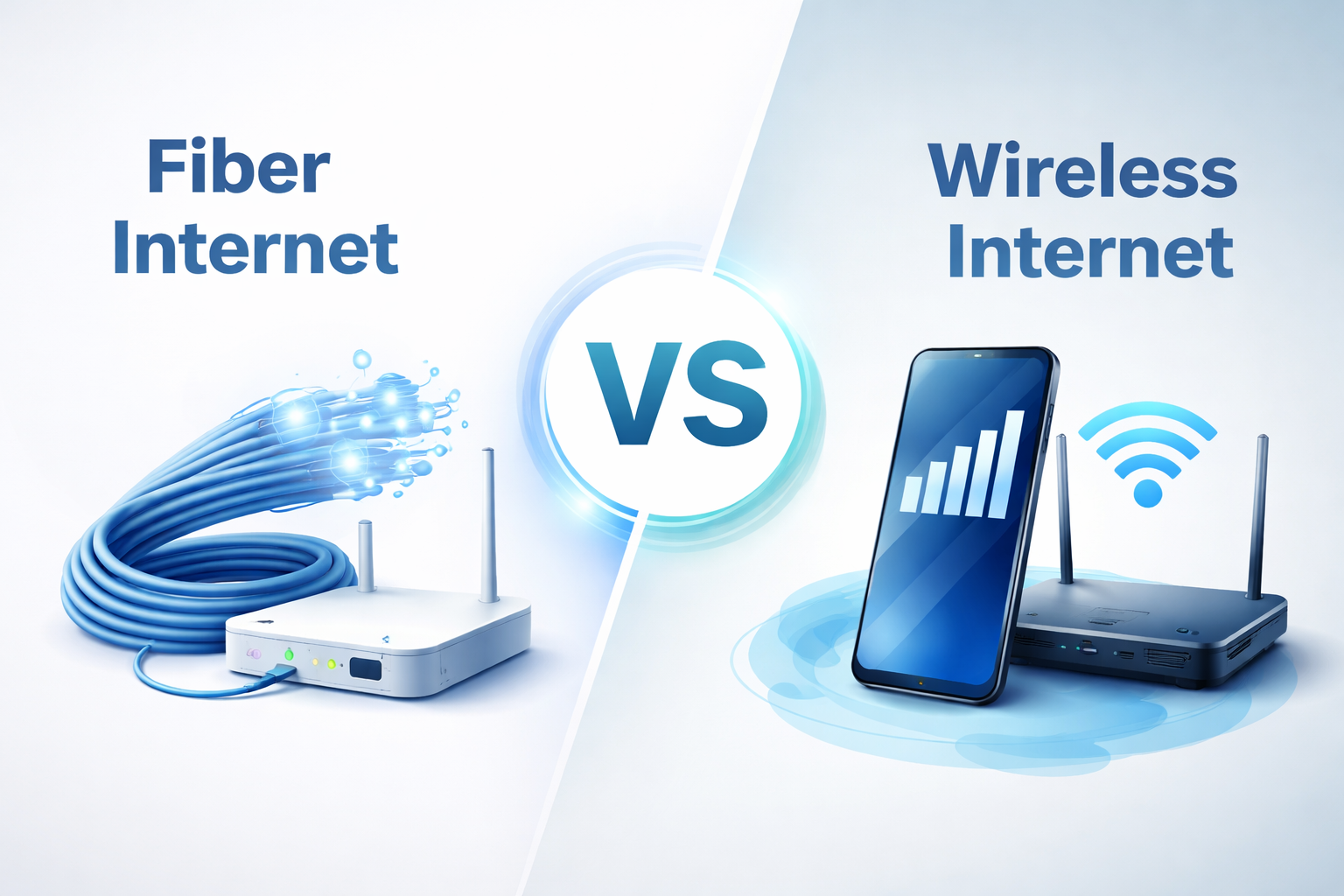
Welcome to the real debate fiber internet vs wireless internet. It’s not just about speed. It’s about how smoothly your life flows in a world that never stops connecting.
Let’s break it down in a way that actually makes sense.
What is Fiber Internet?
Fiber internet is built on something surprisingly simple: light.
Instead of sending data through traditional cables, fiber uses ultra-thin strands of glass or plastic to transmit information at lightning speed. Think of it as a private express lane where your data moves freely, without traffic.
What makes fiber stand out?
-
Extremely fast upload and download speeds
-
Very low delay (latency)
-
Consistent performance even during peak hours
If your internet experience were a road, fiber would be a smooth, empty highway stretching into the horizon.
What is Wireless Internet?
Wireless internet, on the other hand, travels through the air.
It connects your devices using radio signals, whether through mobile networks (like 4G or 5G) or fixed wireless connections.
Why people love wireless:
-
No cables needed
-
Easy to set up
-
Works almost anywhere
But here’s the catch: since it travels through the air, it’s more like a busy city road—shared, sometimes unpredictable, and affected by everything from weather to network traffic.
Fiber vs Wireless: A Simple Comparison
Feature Fiber Internet Wireless Internet
Speed Extremely fast Moderate to fast Reliability Very stable Can fluctuate Latency Very low Higher Mobility Fixed Portable Setup Complex Easy Availability Limited in some areas Widely available
Speed: Does Faster Always Mean Better?
Fiber is undeniably faster.
We’re talking about speeds that can handle:
-
4K streaming without buffering
-
Seamless video calls
-
Online gaming with no lag
-
Large file uploads in seconds
Wireless internet has improved a lot—especially with 5G—but it still depends on signal strength and congestion.
So while wireless can feel fast, fiber feels effortless.
Reliability: The Silent Game-Changer
Speed gets attention, but reliability earns trust.
Wireless connections can be affected by:
-
Weather conditions
-
Network congestion
-
Physical obstacles like walls
Fiber doesn’t have these problems. Once it’s installed, it delivers a steady, predictable connection.
And sometimes, that consistency matters more than raw speed—especially when your work, business, or income depends on staying connected.
Cost: What Are You Really Paying For?
At first glance, wireless internet often looks cheaper.
-
No installation fees
-
Flexible data plans
-
Quick setup
Fiber may require:
-
Installation costs
-
Higher monthly fees
But here’s the deeper truth:
Fiber is an investment in stability. Wireless is an investment in flexibility.
The better choice depends on what you value more.
Availability: The Reality Check
In many places, especially developing regions fiber isn’t always accessible yet.
Wireless internet wins here because:
-
It works almost anywhere
-
It doesn’t require heavy infrastructure
So sometimes, the decision isn’t about preference—it’s about what’s available.
Which One Should You Choose?
Let’s make it simple.
Choose Fiber Internet if:
-
You work remotely or run an online business
-
You stream, game, or upload frequently
-
You want a stable, long-term solution
Choose Wireless Internet if:
-
You’re always on the move
-
Fiber isn’t available in your area
-
You need something quick and flexible
For Businesses: What Works Best?
If your business depends on:
-
Online payments
-
Cloud tools
-
Video communication
Fiber is often the better choice because it reduces downtime and keeps operations smooth.
However, wireless can still be useful for:
-
Small teams
-
Startups
-
Backup connectivity
The smartest setups often combine both.
The Future of Internet: What’s Coming Next?
The world is moving toward a blend of both technologies.
-
Fiber is expanding steadily
-
Wireless (especially 5G) is becoming faster and more reliable
The future isn’t about replacing one with the other—it’s about using both together to create seamless connectivity.
Final Verdict: Which is Better?
There’s no universal winner.
Instead, think of it like this:
-
Fiber is power — strong, fast, and dependable
-
Wireless is freedom — flexible, mobile, and accessible
The best choice depends on your lifestyle, your work, and what matters most to you.
FAQs
1. Is fiber internet always faster than wireless?
Yes, in most cases. Fiber offers higher and more consistent speeds, especially for heavy usage.
2. Can wireless internet replace fiber?
Not completely. While wireless is improving, fiber still leads in speed and reliability.
3. Which is cheaper in the long run?
Wireless may be cheaper upfront, but fiber can offer better value over time due to its stability and performance.
4. Does weather affect wireless internet?
Yes. Rain, storms, and interference can weaken wireless signals, unlike fiber connections.
5. Is fiber internet available everywhere?
No. Fiber is still expanding and may not be available in all locations yet.
Closing Thought
The right internet connection isn’t just about technology.
It’s about how your day feels when everything simply works—no interruptions, no frustration, just flow.
Because in today’s world, connection isn’t a luxury anymore… it’s the quiet foundation of everything you do.